


Master Craftsman Déda transforms gypsum stone from the Pernambuco hinterland into handcrafted sculptures inspired by the cultural identity of Northeast Brazil. A native of Trindade, Pernambuco, Brazil, he dedicates himself to gypsum stone sculpture, preserving artisanal traditions through handcrafted pieces. His work unites art, culture, and the natural beauty of the mineral raw material from the Araripe region.

The works are inspired by Brazilian popular culture, fauna, and elements of the northeastern hinterland, revealing unique forms, natural textures, and hand-carved details. Recognized for his contribution to traditional crafts, he has represented Pernambuco at national and international fairs, exhibitions, and events, bringing the art of gypsum stone from the Pernambuco hinterland to different audiences and cultures.

One of the main works produced by Master Craftsman Déda, the piece "Reinterpretation of Abaporu by Tarsila do Amaral" represents the encounter between artisanal tradition, innovation, and Brazilian cultural identity in the Araripe region of Pernambuco. The work reinterprets one of the greatest icons of Brazilian modernism through gypsum stone, highlighting the organic forms and natural characteristics of the raw material.
Conceived during the Pernambuco Artesão program, carried out by Sebrae Pernambuco and ADEPE, the sculpture received state recognition when it was chosen as the program's official invitation piece. Produced from the sustainable reuse of gypsum, the work transforms waste from the plaster industry into art, uniting culture, sustainability, and Northeastern identity.
More than just a decorative object, the piece establishes a dialogue between the northeastern hinterland and the history of Brazilian art, reinterpreting Tarsila do Amaral's modernist vision from the perspective of the cultural identity of Northeast Brazil. Each sculpture expresses authenticity, memory, sustainability, and the creative force of the people of Araripe.


PRODUCTION PROCESS
The production process for gypsum stone pieces begins with the selection of the raw material, preserving natural characteristics such as texture, tone, and mineral resistance. Each fragment is carefully chosen and prepared to ensure quality and suitability for handcrafted work.
The production emphasizes the sustainable use of gypsum, including the reuse of waste from the gypsum industry in the Araripe region, reducing waste and transforming discarded materials into new artistic possibilities.
Through carving, polishing, and hand-finishing, the raw material is transformed into decorative pieces imbued with cultural identity, authenticity, and artisanal expression. The result is unique sculptures, produced with environmental commitment and appreciation for the traditions of the Pernambuco hinterland.

.png)
Whale M
Carved from gypsum, this piece represents the lightness and majesty of the whale in an elegant and contemporary design with a refined finish, on a translucent selenite base. The work combines delicacy and sophistication, transforming the strength of nature into artistic expression. "The majesty of the ocean translated into the delicacy of gypsum."
.png)
Holy Spirit P
Carved from gypsum stone, it represents peace, purity, divine presence, renewal, and the manifestation of God among men. In sacred art and sculptures, the dove is often the strongest and most universal representation, especially when associated with peace, protection, and spirituality.
.png)
Owl P
Carved from natural gypsum, the owl symbolizes wisdom, protection, and sensitivity. With rich geometric details and a refined finish, the piece highlights the natural veins of the stone, transforming each sculpture into a unique work, marked by elegance and artisanal strength.
.png)
Soulmate
With fluid shapes and an organic design, this sculpture in natural gypsum represents the connection, affection, and harmony between two souls. The natural veins of the stone lend movement and exclusivity to the piece, transforming emotion into contemporary art; the red selenite heart highlights the love between the two.
.png)
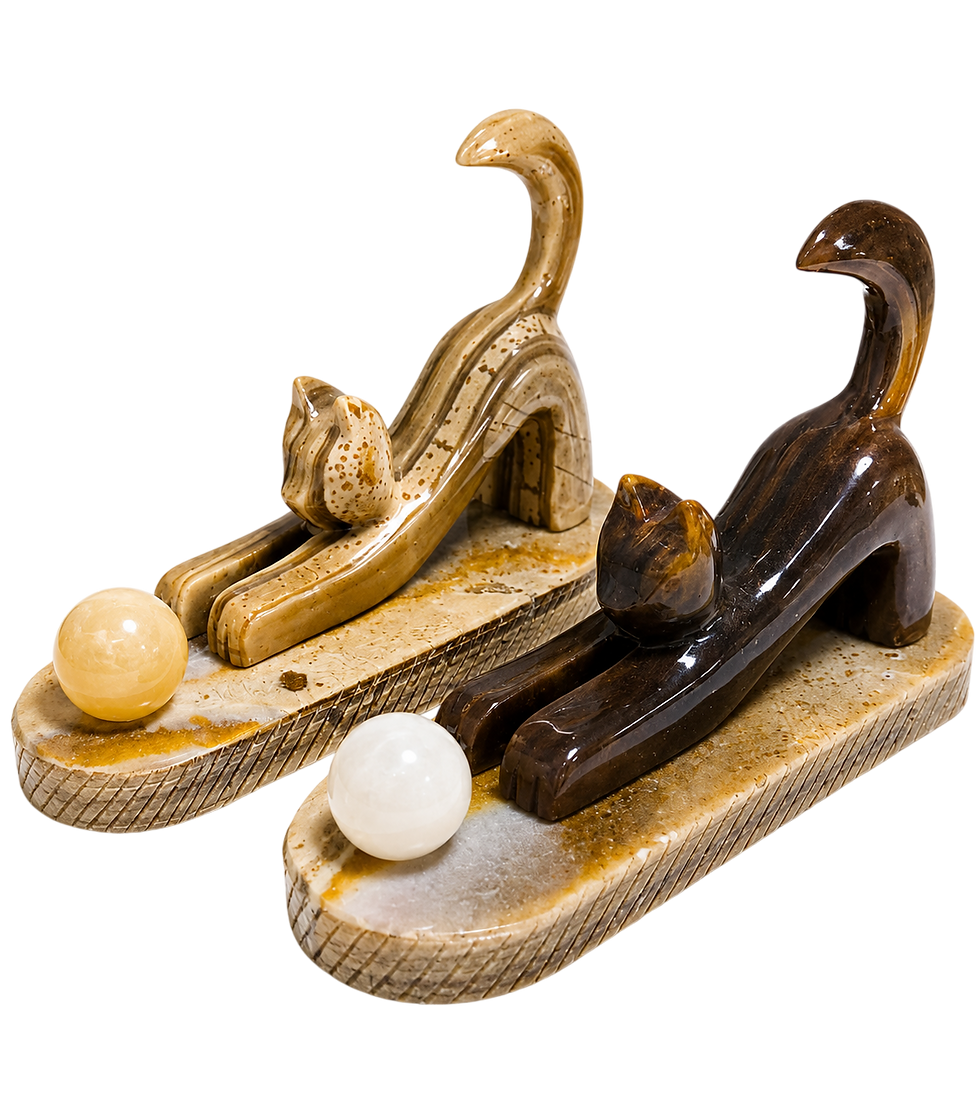
Gatinho de gipsita com esfera de selenita
A kitten made of natural gypsum interacting with a selenite sphere, symbolizing protection, lightness, and spiritual balance.
.png)
Carranca
The carranca, a symbol of protection and ancestry in the waters of the São Francisco River, gains a contemporary interpretation through handcrafted sculpture in natural gypsum, revealing the authenticity of Brazilian mineral art. Featuring the characteristic traits of Master Craftsman Déda, the carranca has a more rectilinear shape and subtle lines in its teeth.
.png)
Pedacinho do Sertão
Created from natural gypsum stone, this handcrafted sculpture brings together three symbolic elements of the northeastern backlands of Brazil on a rounded base. The mandacaru cactus, an emblematic plant of the region, shares space with another rounded cactus, popularly known as "crown of the friar," represented with delicate upper details reminiscent of its small flower buds. Complementing the composition, the hoe symbolizes the work of the small farmer in the backlands. The shades of the gypsum stone make each piece unique.
.png)
Tucano
Handcrafted sculpture in natural gypsum stone representing a toucan perched on a base inspired by a tree trunk. The piece highlights the bird's large, curved, and elongated beak, contrasting with its compact body and delicate hand-carved details. The veins, tones, and organic patterns of the stone vary naturally between light and dark shades, making each piece unique and marked by the authenticity of Brazilian mineral art.

